The Woodfin Boys of Rutherford County
When the War Between the States came to Tennessee, there was little doubt that the Woodfins of Rutherford County would be in the fight. When the state left the Union and called for volunteers to join the new Army of Tennessee, the four oldest Woodfin brothers signed up. Their father, even at age 72, tried to enlist. That was part of the Woodfin heritage. For more than a century, the Woodfins had answered every call to defend their homeland.
 |
| Post Office at Fosterville TN |
Nicholas later fought in the War of 1812 in an Ohio militia regiment under Gen. William Henry Harrison, the governor of the Indiana Territory who would later be the nation's ninth President. After the war, Nicholas and his Virginian wife, Hanna Mary Ashbrook, moved to North Carolina, then to Middle Tennessee where they created a large farm on Brothers Road south of Murfreesboro near Fosterville. When Nicholas died in 1832, his son Samuel got a share of the land. Samuel, too, had fought the British in the War of 1812 and had also served under a future President. He was among Rutherford County's first volunteers to follow fellow Tennessean Andrew Jackson to fight the Battle of New Orleans. After the war, Samuel returned to Tennessee and married 20-year-old Mariah Barnhill.
As the tension between Northern and Southern states increased, Tennessee was pulled from both directions. Memphis and West Tennessee favored the Southern cause while Knoxville in the east was pro-Union with Middle Tennessee divided between the two camps. Early in 1861, as Abraham Lincoln was preparing to be sworn in as President, residents of Tennessee's central counties voted to support secession, but only by a narrow 51-49 percent margin.
Samuel was a respected landowner and a county commissioner who hoped Tennessee could avoid going to war. At public forums, he spoke against secession on practical rather than political grounds. The Union, he argued, had the advantage with more men, arms, forts and ammunition. If Tennessee bolted, he believed, the federal government would not let it go quietly. He correctly predicted that the state would become a battleground, it's government upended and its farms and towns plunged into poverty.
But he also vowed to that he would not desert his homeland. A family story says that during one speech, Samuel was interrupted by a man who called him a coward for speaking against war. He replied that he had three sons of fighting age and "they will all volunteer in the event our state calls them."
 |
| Hugh Lawson White Woodfin |
When the call did come, Samuel actually saw four sons go off to fight. The first to enlist was 20-year-old Hugh Lawson White Woodfin. He was named after Hugh Lawson White, a lawyer and judge from Knoxville who followed Andrew Jackson into the U.S. Senate, then ran for President from the Whig Party in 1836. Hugh Woodfin signed up in May of 1861, about two weeks before another referendum made Tennessee's exit from the Union official. He joined Tennessee's 18th Infantry Regiment which marched north into Kentucky where it occupied Bowling Green. When the Confederates left Kentucky, his regiment became part of the garrison guarding Fort Donelson on the Cumberland River.
 Hugh was joined in the fall of 1862 by three other Woodfin brothers. Samuel Chase, 24, enlisted on Oct. 14 in Knoxville. Tom, 18, signed up Nov. 11 in La Vergne and both brothers joined Hugh in the 18th Regiment as privates in Company F. Moses, 33, enlisted Nov. 12 at Murfreesboro to follow Col. Anderson Searcy in the 45th Tennessee Infantry.
 |
| Col. Joseph B. Palmer |
In early February, Union forces captured Fort Henry on the Tennessee River, then marched 12 miles east to attack Fort Donelson. The Union Navy bombarded the fort while troops under the command of Ulysses S. Grant cut off its supply lines and escape routes.
 |
| Battery at Fort Donelson overlooking the Cumberland River. |
On the 16th, Moore said the regiment marched out of the fort to a nearby town, then turned around and returned to find a white flag flying over the fort. With the situation apparently hopeless, Brig. Gen. Simon B. Buckner from Kentucky had asked Grant, his one-time Army friend, what terms he would offer to end the shelling. Grant replied that the only terms he would accept was "unconditional surrender." Buckner called Grant's reply "unchivalrous," but he reluctantly agreed.


Hugh Woodfin stayed true to the Confederate cause. Documents show that he was sent to Vicksburg on Sept. 23, 1862, and he may have been back in Rutherford County when his brothers Tom, Moses, and Samuel Chase enlisted later that fall.
Stones River
 |
| Battle of Stones River |
 |
| Braxton Bragg |
But Tom was lost before he saw his first battle. In December of 1862, just a month after he had enlisted, the Woodfin brothers were camped in the ruins of an abandoned flour mill on the banks of the Stones River just outside Murfreesboro. Finding themselves short of food, they collected dried bits of flour from the rafters of the old mill, mixed it with river water, and made crude biscuits that they toasted on bayonets over a campfire.
 |
| John C. Breckinridge |
At Stones River, the 18th Regiment was part of a brigade commanded by Gen. John C. Breckinridge. Like Palmer, Breckinridge was a Southerner who had supported the Union and opposed secession before the war. Born in Kentucky, Breckinridge had been one of the state's U.S. Senators and James Buchanan's vice president. He was the Democratic Party's candidate for President in the fractured 1860 election that Lincoln won.
 |
| Stones River at McFadden's Ford |
As the new year approached, the Union army confronted Bragg's troops in the rocky fields and forests along Stones River. Palmer and his regiments were stationed on the east bank of the river at the far right of the Confederate defenses. The two armies made camp the night of December 30 and while the generals planned the next day's attacks, military bands began their usual evening serenades. Each side could hear the enemy's band just a few hundred yards away and when one of the bands struck up "Home Sweet Home," musicians on both sides joined in.
The Southerners struck first, marching out of a misty dawn to attack the Union's left flank. The Yankees retreated and regrouped throughout the morning until units from Indiana, Ohio and Kentucky were compressed into an area the locals called the Round Forest which straddled the Nashville Pike. A Union brigade led by Col. William B. Hazen, with help from artillery, turned back four successive charges. The fighting that was so severe the soldiers named the place "Hell's Half Acre."
 |
| Hazen monument |
Palmer likely saw little chance of success where three other assaults had failed. In his book "No Better Place To Die," Peter Cozzens said Palmer "marched his Tennesseans into the cedars west of the Cowan farm correctly but, contrary to orders, they never came out." Palmer's casualties were relatively light - just two men killed and 20 wounded, including Hugh Woodfin who stayed with his unit. Hazen’s men were the only Union soldiers to hold their position throughout the fighting. They marked the victory by erecting what today is the oldest intact Civil War monument in the nation.
 |
| Looking uphill from the banks of Stones River toward the Union artillery position |
The attack was ordered to start late in the day at 4 p.m. By then Union forces had more than 50 large guns on the hill with a clear view of any enemy approaches. Breckinridge objected to a mission he believed was clearly suicidal. When Bragg insisted, Breckinridge told one of his officers that "this attack is made against my judgment and by special orders of General Bragg." If he should be killed, Breckinridge asked his his friend to "do justice of my memory and tell the people that I believed this attack to be very unwise and tried to prevent it.”
 |
| Noah J. Hampton |
Hampton said the regiment marched across a cornfield and up a western slope. "They opened on us with fifty pieces of grape and canister, besides the musketry. This charge lasted about twenty-five minutes. Our men were mowed down until there were gaps of about twenty steps. I myself shot 34 cartridges. We were compelled to fall back, and that gave the enemy a chance to take good aim at us." Although the 18th Regiment may have avoided the worst of the fire, it took its share. "During this charge our colonel, J. B. Palmer, was wounded three times, three flag bearers shot down, twenty-two bullet holes shot in the banner, and a flagstaff cut half in two," Hampton said.
Out of 430 troops, the 18th Regiment saw 166 killed or wounded. Casualties for the entire army were just as severe. When the exhausted Confederates finally withdrew from Stones River, Bragg had lost 10,266 men and the Union had lost 13,249. The toll of killed and wounded would be the highest percentage of casualties of any major battle in the Civil War.
Tullahoma
 |
| Marker in the Confederate cemetery at Beech Grove at the south end of Hoover's Gap |
During the time Bragg's army was camped near Tullahoma, Breckinridge was sent to Mississippi and would go on to be the Secretary of War until the Confederacy dissolved. He was replaced by Col. John C. Brown, a Tennessee lawyer who left his practice in 1861 to enlist. He started as a private but quickly rose to the rank of colonel. He fought at Perryville in Kentucky and was at Fort Donelson with Hugh Woodfin when the Confederates surrendered and were later exchanged. Brown's Brigade was under the command of A. P. Stewart, another Tennessean who his men called "Old Straight."
 |
| John C. Brown |
To get to Bragg and Tullahoma, the Union Army would have to come through at least one of several gaps or low passages where rough farm roads slipped between between heavily wooded hills. One route followed what is now U.S. 41 through Hoover's Gap toward the crossroads settlement of Beechgrove. Another followed Short Creek toward Liberty Gap south of Fosterville near a farm owned by Anthony Clark, one of the area's early settlers. When the bluecoats entered Rutherford County and passed near the Woodfin farm, the old warrior from the Battle of New Orleans was not there to see them. Samuel Woodfin had died in April at age 74, about six weeks after the death of his wife, Mariah.
 The force aiming at Hoover's Gap was led by Rosecrans' new secret weapon. It was a mounted infantry unit called the Lightning Brigade because it was designed to move fast and hit hard. Its leader, Col. John T. Wilder, was a mechanical engineer and foundry owner from Greensburg, Ind., who had moved quickly up the ranks after joining the army as a private. It was Wilder's idea to take infantry soldiers, put them on horseback, and use them as fast-moving shock troops. In addition to their speed, Wilder's troops had another significant advantage over their opponents -- a new repeating rifle that could fire as many as 20 rounds in the time it took a Confederate soldier to fire two.
The rifle was developed by Christopher M. Spencer who once worked for Samuel Colt. Earlier that year, Spencer had walked into the White House and convinced President Lincoln to take a look at his new invention. Lincoln had a natural curiosity about mechanical devices and new weapons and he joined Spencer and Secretary of War Edwin Stanton for some target practice near the site of the Washington Monument. The government eventually ordered thousands of the new rifles and Wilder arranged for his men to buy them for $35 each with payments taken out of their army pay.

When Wilder's strike force thundered into Hoover's Gap, they surprised and scattered a Kentucky cavalry unit, then pushed on toward a Confederate infantry camp at Beechgrove at the far end of the gap. When he arrived, Wilder was shocked to find the camp was empty. Most of the rebel troops were camped two miles away and most of the officers were away at a Masonic picnic.
When the Confederates finally organized an attack on Wilder's troops, his men got a rude introduction to the Spencer rifle. Wilder's men were severely outnumbered, but their superior firepower allowed them to hold their position until infantry reinforcements arrived. It was a similar story at Liberty Gap where the leading Union strike force was also mounted infantry armed with Spencer rifles.
 "They didn't know we had the 'Spencers,' " Col. James Connolly recounted in a letter to his wife about the attack at Hoover's Gap. Their rebel yell "was answered by another terrible volley, and another and another without cessation, until the poor regiment was literally cut to pieces and but few men of that 20th Tennessee that attempted the charge will ever charge again."
While the Southerners were losing Hoover's Gap, other Confederate units a few miles to the west were being pushed out of Liberty Gap. One family history said the Woodfin brothers fought at Liberty Gap "where they shot so many Yankees they ran out of rifle shot." But other accounts and army records show the Woodfins were scattered around the area, some well away from the fighting. Moses was with the 45th Regiment.
A profile of the 45th published in The Murfreesboro Post said "fortunately, the unit did miss the fight at Hoover's Gap." The 18th Regiment, which counted Hugh and Samuel Chase, was temporarily assigned to Bushrod Johnson's brigade. They were called up from a reserve position on the 25th to try to push the Yankees out of Hoover's Gap but by the time they arrived, after marching through a steady rain, Wilder's troops had been reinforced and dug in. The next day the Confederate units began retreating back toward Tullahoma.
 |
| Civil War hospital in Tullahoma |
After the Union troops broke through the gaps, Bragg packed up his headquarters and headed south. On July 3 - the same day that Vicksburg fell to Grant in Mississippi and Robert E. Lee withdrew from Gettysburg - Bragg's army began moving south across the Cumberland Plateau to Chattanooga. Moses and Samuel Chase also left their home area, moving out with Brown's Brigade, but not their brother Hugh. His records show that he was captured on July 1 near Tullahoma. Hugh's service records include one document listing him among soldiers who deserted from Brown's Brigade during the retreat. Whether he was captured in combat or in surrender, he was now in Union hands. Hugh was sent to Louisville, then on to the Union prison at Camp Chase near Columbus, Ohio, and later transferred to Camp Douglas in Chicago, a notorious POW camp that some called the Andersonville of the north. It was Hugh's third visit to a Yankee prison and this time there would be no parole or exchange.
Chickamauga
 |
| Battle of Chickamauga |
The did not sit well with the Tennessee volunteers who had been fighting on their home soil for more than a year and many refused to go. Peter Cozzens, in his book "This Terrible Sound," quoted George Dillon of the 18th Regiment: "After crossing the state line many Tennesseans refused to serve our country longer thinking that we were on the retreat and shamefully deserted our army." Gen. Stewart told his men that the departure was not another retreat but a strategic move and that they would soon "meet the enemy in a deadly conflict."
 |
| Brotherton cabin and farm |
Bragg did have an offensive plan. He wanted to insert his army between two pursuing Union armies and mount an attack before they could consolidate. He aimed his wedge at the rolling woods and farm fields west of Chickamauga Creek. On Sept. 19, Stewart's division had crossed the creek at Thedford Ford with orders to move toward the sound of the guns, which turned out to be northwest toward Lafayette Road and the farm fields of the Brotherton and Poe families. In addition Brown and his five Tennessee regiments, Stewart had a brigade under Tennessean William Bate and another under Alabamaian Henry Clayton.
Early in the afternoon, the rebels bumped into Union regiments from Indiana and Ohio stationed in the open woods east of Lafayette Road and Stewart sent Clayton in first. The two sides stood and traded volleys, often shooting wildly, Clayton would later report, until his men ran low on ammunition. Then it was Brown's turn to take the field.
With the 18th and 45th regiments anchoring the right wing of his advance, Brown's troops recaptured a battery of rebel guns that had been lost earlier in the day. But the Federals also had fresh troops and plenty of them. Indiana's 75th Regiment, with more than 700 men, was far larger than other regiments because it was made up of untested recruits who had never been in combat. When they poured in from the Union left, the Rutherford County boys got hit first.
Cozzens described the attack: "The Seventy-fifth struck the right flank of Brown's brigade like a whirlwind, hitting the Eighteenth Tennessee first. The Tennesseans, he said, "never had a chance." Pvt. Hampton said the fighting was close and confusing. "There was such a volume of smoke we could not distinguish the enemy from our own men ten steps away." At one point, he said his company fired a volley at another group of Confederates, mistaking them for Yankees.
Among the casualties in the 18th was Col. Palmer who took a bullet in his right arm and fell from his horse with blood spurting from a torn artery. Next in command was Lt. Col. William Butler, who also went down. With Capt. Gideon Lowe in charge, the 18th turned and headed for the rear with the 45th and the rest of the brigade not far behind.
 |
| King monument at the Poe Field |
The next morning, Stewart's brigades shifted to the north to make room for Confederate reinforcements. Gen. James Longstreet had arrived with seasoned troops that had fought at Gettysburg. When Brown's regiments stepped off, with the 18th and 45th regiments in the lead, they aimed at the cabin on the Poe farm on the west side of Lafayette Road. Col. Anderson Searcy of the 45th said the regiments moved in good order, "but rather too fast; it seemed impossible to restrain them."
 |
| Monument to IN 101st |
The two regiments crossed the road and pushed on toward the Federal defenses at the far end of the Poe field where the the Indiana 75th Regiment again waiting for them along with other Hoosiers in King's Brigade. When the Tennesseans were 50 yards from the tree line, the Federals opened fire. The rebels wavered, then retreated in some confusion. As Brown tried to rally his battered regiments, he was knocked off his horse and slightly wounded. Hampton recalled constant firing for six hours. "The woods caught fire," he said, "burning our wounded men before we could take them up."
While Brown's troops were reforming, Longstreet's forces exploited a hole in the Union line. It swept across Brotherton field and pushed the Federals to the northwest where they rallied at the Snodgrass Farm and at nearby Horseshoe Ridge. Maj. Gen. George Thomas eventually organized a strong defense, earning him the title of "The Rock of Chickamauga."
The battle was the Confederacy's biggest success since it left Murfreesboro nine months earlier. But it cost Bragg 18,454 casualties -- 2,000 more than the Union Army lost -- and the Federals were still in control of Chattanooga.
Lookout Mountain and Missionary Ridge
 |
| Battle of Missionary Ridge |
For two months, Union and Confederate troops were camped facing each other. The soldiers reached an informal agreement that they wouldn't fire on each other until the next full-scale assault. With their lines only 100 yards apart, Hampton said "we became very friendly exchanging tobacco for coffee and reading each other's newspapers when the officers were not watching us."
After Chickamauga, the depleted 18th and 26th regiments were combined and put under the command of Lt. Col. Butler while Col. Palmer was recuperating. In early November, Brown's Brigade was transferred to a division headed by Major-General Carter Stevenson, a Virginian and West Pointer who had come to Chattanooga after the fall of Vicksburg. His headquarters was high on Lookout Mountain at the Cravens House where his porch commanded a spectacular view of the city below. Some of the soldiers in Brown's Brigade had an even better view from the artillery positions on the mountain's highest point.
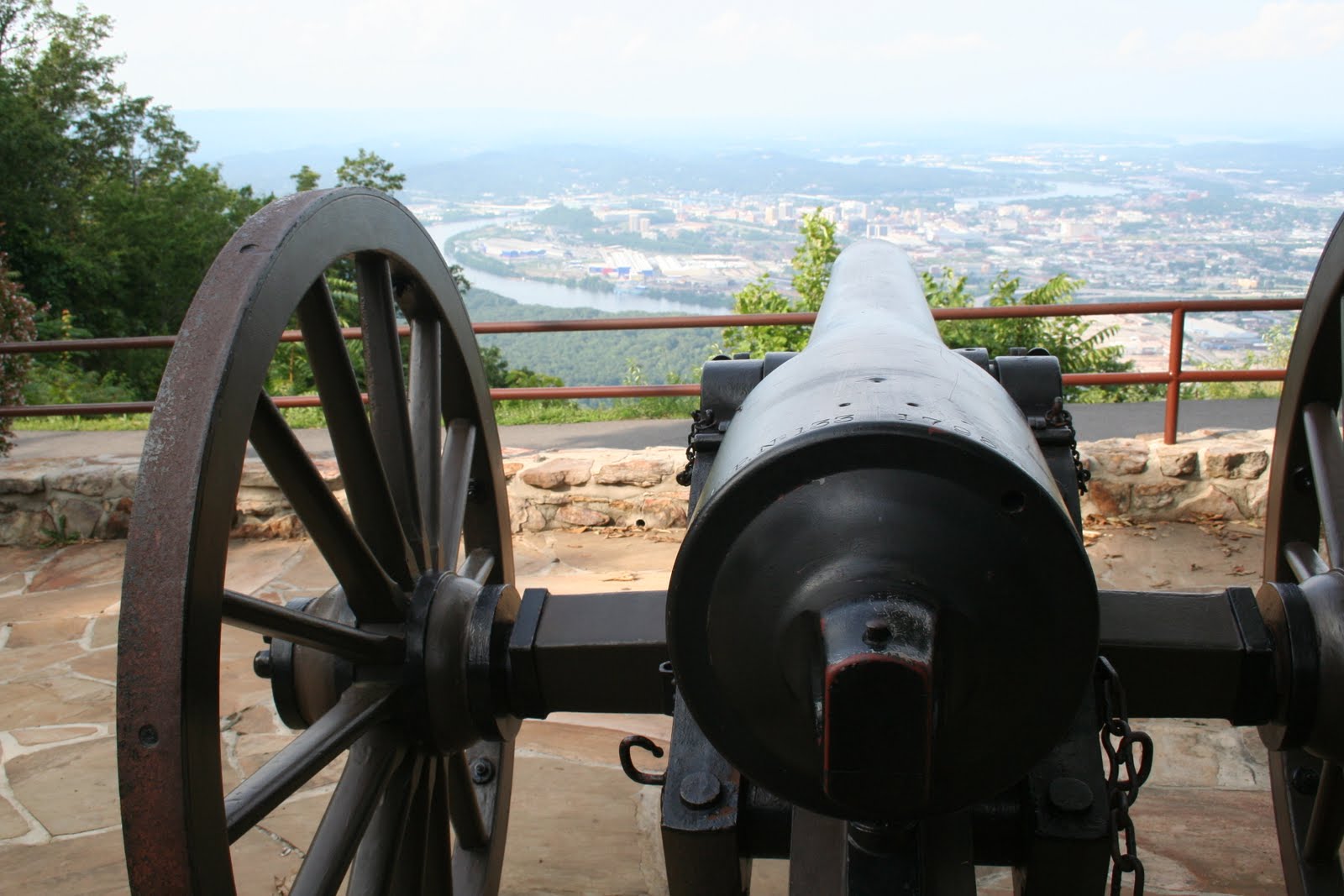 |
| Point Park on Lookout Mountain |
On the morning of Nov. 24, Brown's troops were fanned out along the western face of Lookout Mountain, watching for an expected Union advance below. There wasn't much to see. Thick clouds of mist covered the valley, screening the Federals as they made their way across Lookout Creek and along the foot of the mountain. Blinded by the fog, rebel skirmishers fired at what they could hear. "The fog was so dense," said Brown, "that we could not see the enemy, although we could hear his march, and guided by this and the report of his musketry ours was directed."
 |
| Cravens House |
Stevenson placed the brigade on the top of the ridge above the Chattanooga & Cleveland Railroad tunnel, then sent them down the hill to set up defenses south of the Glass Farm on the flat ground that offered an approach to the tunnel. With the help of artillery posted on the hill above the tunnel, the Confederates turned back several attacks by Sherman's forces.
 |
| Railroad tunnel under Missionary Ridge |
 |
| Moses Woodfin |
 Federal troops scrambled up the face of Missionary Ridge chanting "Chickamauga," Chickamauga" as they overran three successive breastworks on their way to the top. Hampton made his escape down the back side of the ridge. Samuel Chase Woodfin, who may have been in the fight or still in a Confederate hospital, joined the retreat further south toward Dalton, Georgia.
For Moses, the war ended on Missionary Ridge. According to family history, Moses was wounded once at Chickamauga and again at Missionary Ridge while he was dragging a cousin named Will Peak to safety. His regiment's muster roll for early 1864 contains this notation: "Supposed to have been captured at Missionary Ridge November 25 1863." Union records show Moses was indeed in Federal hands. He arrived in Louisville as a prisoner of war on Dec. 10 and entered Rock Island Prison in Illinois on Dec. 13.
Another family story describes Moses Woodfin's trip north with other prisoners in an open boxcar. As the train passed through Fosterville, Moses was considering jumping to freedom when one of the other prisoners spoke up. He pointed out to Moses how close he was to his home and how he could walk to the family farm if jumped from the train. Overhearing the conversation, a Union guard closed and bolted the boxcar door, ending Moses' hope for an escape.
Georgia
 |
| Battle of Kennesaw Mountain |
In the spring, the Union army marched out of Tennessee with a new commander, Gen. William T. Sherman. The opposing armies hopscotched south, fighting a series of small skirmishes as Johnston retreated closer to Atlanta.
Sherman's first fight came in early May when Union forces attacked Confederates holding the high ground north of Dalton along Rocky Face Ridge, Hampton said his company was camped at the top of a ridge where the rebels had positioned boulders to push down on the Yankees below. One night on picket duty, he heard the Union soldiers call out "O Johnny Reb don't roll any rocks down on us." They would answer, "All right Billy Yank, if you don't shoot."
 |
| Joseph E. Johnston |
Over the next few weeks, the armies clashed at New Hope Church (May 25-June 4), Powder Springs Road, near Marietta (June 20), and Kennesaw Mountain (June 27). The month of July saw the Confederates defending Atlanta at its outskirts along the Chattahoochee River.
 |
| Defenses at Atlanta |
Back to Tennessee
 |
| Battle of Franklin |
The army returned to Dalton in October, then headed southwest to Alabama before turning toward Tennessee. In November, Joseph Palmer returned to the field and took charge of troops that included a consolidated regiment made up of elements from the 18th and 26th regiments.
Hood's army moved through Columbia and Spring Hill before marching on Franklin. On November 30, the leading edge of the army came face to face with Union troops at a defensive line on the south side of town. Several regiments, including the 18th/26th, which had occupied Columbia, were still miles away at 4 p.m. when Hood ordered a frontal assault on the Union fortifications. The attack, sometimes called "Pickett's Charge of the West," was a disaster for the rebels. When the fight stopped after dark, the Confederates had suffered 6,252 casualties, including 1,750 killed and six generals were either killed or mortally wounded.
 |
| John Bell Hood |
On December 5, Hood sent Forrest's cavalry and an infantry force that included Palmer and men from the 18th Regiment south to attack Union garrisons along the rail lines near Murfreesboro. Palmer’s infantry brigades joined Forrest’s command on December 6 and the next day Union troops marched out of Murfreesboro to confront the rebels. It wasn't much of a fight. "Most of the infantry under my command were barefoot and in disabled condition," Forrest would later write. In the end, Forrest had destroyed some railroad track and burned a few houses, but not much else.
Back in Nashville on December 15, Forrest and Palmer were still gone when Union troops stormed out of their trenches and all but destroyed the Army of Tennessee. Hood had entered the state with more than 30,000 men but when he retreated south across the Tennessee River he had fewer than 10,000. Woodfin's 18th Regiment had all but disappeared. Camped at Columbia, Tenn., on Dec. 23, the regiment reported 12 men and three servants. A collection of Tennesseans patched together from survivors of the 18th and other units fought as the rear guard protecting what was left of Hood's army as it retreated south. On December 27, Woodfin was one of the last Confederates to leave the state when his unit crossed the Tennessee River near Florence, Ala.
 |
| Battle of Bentonville |
The Confederates skirmished throughout the early spring and even enjoyed some success in a fight near Bentonville on March 19 and 20. In that fight, about 75 men, including some from the 18th Regiment, charged so far through the Union lines that they found themselves behind the Yankee troops. They hid in the underbrush through the night, then slipped around the Union's left flank and made their way back to their own camp.
 |
| Samuel Woodfin's discharge certificate |
Woodfin headed toward home as the escort for a herd of cattle destined for a Union supply depot in North Carolina. That story was recounted by Samuel Chase's son, Roy, who founded a newspaper called the Hustler in South Pittsburg near Chattanooga in 1899. Writing in a profile published in 1934, Roy said his father returned to Fosterville but found that the family home was now occupied by strangers.
 |
| Entrance to the farm on Brothers Road once owned by Samuel and Mariah Woodfin |
While Samuel Chase was walking home from North Carolina, Moses and Hugh also headed back to Tennessee. All three brothers remained in Rutherford County. They hired out to work on area farms and each one married a girl from the Clark family. Moses had married Rachel Clark in 1856 and Hugh married her sister, Mary Elizabeth Clark. In 1867, Samuel Chase married the girls' half cousin, Elizabeth Frances Clark. All three women were related to Anthony Clark whose farm had been the site of some of the fighting at Liberty Gap.
 |
| Amira Ellen Woodfin |
In the same year that Samuel Chase and Elizabeth moved to South Pittsburg, their oldest daughter, Amira Ellen, married Charles Nelson Womack of nearby Fackler, Alabama. Womack was the son of another Confederate veteran, John Tipton Womack, who had served in an Alabama infantry unit that guarded Fort Morgan at the entrance to Mobile Bay.
The oldest child of Charles and Amira Ellen was Larada Nelson Womack who they called Nell. The family was living in Oklahoma and Nell was a teenager when she met Michael Manning, a barber and musician who had come to America as an infant when his parents emigrated from Sicily in 1893. Michael was 19 and Nell was 17 when they were married at her father's home in 1911. Their first son was my father, Charles Russell Manning.
Sources
Tennessee's Battered Brigadier - The Life and Times of General Joseph B. Palmer CSA
by Robert O. Neff
Six Armies in Tennessee - The Chickamauga and Chattanooga Campaign
by Steven E. Woodworth
The Confederacy's Last Hurrah - Spring Hill, Franklin and Nashville
by Wiley Sword
No Better Place to Die - The Battle of Stones River
by Peter Cozzens
An eyewitness to the dark days of 1861-65
by Noah Jasper Hampton
Tullahoma - The 1863 Campaign for the Control of Middle Tennessee
by Michael R. Bradley
The shipwreck of their hopes: The battles for Chattanooga
by Peter Cozzens
History of the Seventy-Fifth Regiment Indiana Volunteers
By David Bittle Floyd
His Cross of Honor Prized Next to His Bible
by Roy Woodfin, South Pittsburg Hustler, June 7, 1934


