Monday, September 7, 2009

Tuesday, September 1, 2009
George Foster

John and Sarah Foster had come to America from England in 1843 aboard a ship called the Tallahassee that departed from Liverpool. Both were from the Staffordshire area and they were following Foster's sister, Mary, who had emigrated nine years earlier.
John and Sarah settled in Central New York's Otsego County, an area of lush rolling hills and rich farmland. It was the ancestral home of James Fenimore Cooper and the setting for some of his novels about the settlers and Indians in the years before the American Revolution. Cooperstown, the Otsego County seat, was named for the author's father but is better known as the home of baseball's Hall of Fame.
After their parents' death, John and his four siblings were likely taken in by friends or relatives. The 1860 census lists sixteen-year-old George and his seven-year-old brother, William, living in Otsego County with John and Hephzibah Frone.
After the Civil War began, Central New York became a rich source of recruits for the Union Army. In the fall of 1862, when President Lincoln issued a call for 300,000 more men, the war was not going well for the Union. That summer, the Federals had been defeated for a second time at Bull Run. Robert E. Lee's army had crossed the Potomac River and was not far from Washington, and Confederate troops had marched into Kentucky and almost brought the state into the Confederacy.

 |
| Alonzo Ferguson |
The regiment officially became part of the Union Army on Oct. 15, 1862 and six days later, the troops boarded a train bound for New York City. Using trains, ferry boats, steamships and their feet, they made their way across New Jersey and through Philadelphia and Baltimore to the outskirts of Washington where they built a winter camp along the Potomac River They called it Camp Marcy. The regiment spent three months guarding roads and building fortifications that would be used two years later to help repel Confederate General Jubal Early when he invaded the Washington suburbs.
 |
| Illustrated London News via Wikipedia |
After helping keep order in other cities in New York, the 152nd went back to Virginia in October and by early December it was in winter quarters near Stevensburg, about halfway between Washington and Richmond. Col. Ferguson, who had been in poor health, resigned his commission and left the regiment in the hands of Lt. Col. Thompson.
Through the winter, men in the regiment stayed in contact with soldiers in the 121st, the other regiment from their home area. Delevan Bates was a 2nd Lieutenant in the 121st who would go on to become a brevet brigadier general and Medal of Honor recipient. After the war, Bates wrote a series of articles about both regiments for newspapers in Nebraska and New York. In one of them, he described the winter of 1863-64 as "rather pleasant for the whole army. The Christian Commission furnished literature, many extras in the way of clothing and rations were received in boxes from home, entertainments were gotten up by the members of each regiment, brigade drills and also company and regimental exercises were regularly observed."
The Wilderness
 |
| Battle of the Wilderness |
Owen was commander of the Philadelphia Brigade which defended Cemetery Ridge at Gettysburg, but did so without Owen. The unit had been accused of poor discipline and Owen had been replaced shortly before the fight. When he returned to the brigade in Virginia, it was composed of four regiments from Pennsylvania, the 69th, 71st, 72nd and 106th, plus New York's 152nd.
 |
| Joshua T. Owen |
 At first, the Yankees seemed to have the advantage. Civil War historian James M. McPherson wrote in "Battle Cry of Freedom" that the Federals put more than 70,000 men into action compared to fewer than 40,000 rebels. "But the Southerners knew the terrain, and the Yankees' preponderance of troops produced only immobility in these dense, smoke-filled woods where soldiers could rarely see the enemy, units blundered the wrong way in the directionless jungle, friendly troops fired on each other by mistake, and gaps in the opposing line went unexploited because unseen, while muzzle flashes and exploding shells set the underbrush on fire to threaten wounded men with a fiery death."
Troops in Foster's company spent the night of May 4 sleeping on the ground, clutching their muskets. The fighting resumed at dawn and again it was more chaos. "The enemy could be felt but not seen," said Roback. "Nor could they see our force as we drove them onward. The forest was so dense and covered with a thick undergrowth of scrub oak, laurel and sassafras, that the aim was taken only at flashes and lines of smoke."
The New Yorkers and other units pushed the rebels so far back that they stumbled into a clearing where Gen. Lee had his headquarters. Lee retreated to safety, but one of his top generals, James Longstreet became one of the casualties of chaos when he was severely wounded by shots from another Confederate unit.
Spotsylvania Court House
 |
| Spotsylvania Court House |
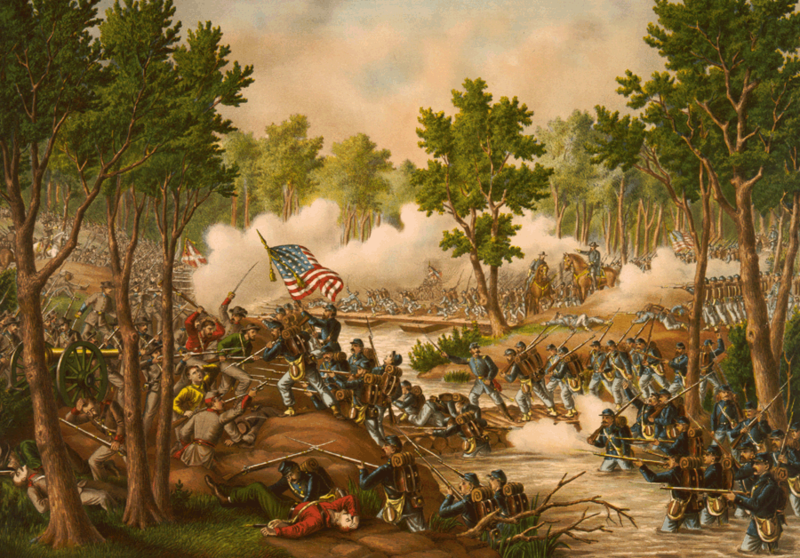
"The dead, dying and wounded are lying literally in heaps, hideous to look at," wrote Roback. The firing was so intense and continuous that the oak trees were torn to shreds and one oak with a two-foot trunk was toppled by gunfire. When the fighting ended on May 13, the 152nd counted 49 men killed or wounded.
Cold Harbor
 |
| Cold Harbor |
Foster and the rest of the 152nd Regiment marched all night and arrived at Cold Harbor, exhausted, early on the morning of June 2. Grant wanted to attack that evening, but he postponed the assault when a severe thunderstorm moved into the area. The delay gave Lee more time to strengthen his defenses and when nearly 50,000 Union troops launched their assault the next morning, the rebels were ready for them.
"Ascending the hill, we madly charge across the level space, and are met with a cyclone of bullets," said Roback. His unit captured three cannon, but were soon forced to retreat a few hundred feet from the enemy fort where soldiers "began to throw up breastworks using case knives and tin plates." For the rest of the day, both sides kept up a continuous barrage until Grant called a cease file.
Although the attacks stopped, Lee refused to allow a truce to remove the dead a wounded. For four days, soldiers on both sides huddled behind their embankments listening to the cries and moans of wounded comrades they could not reach. Anyone who ventured into no man's land to help was an easy target for snipers. When the two armies finally broke off after two weeks of almost constant fighting, the Federals had lost 12,000 killed, wounded or captured while the Confederates suffered almost 4,000 casualties.
In the 152nd, the count was eight killed and five wounded. And Cold Harbor would be the last battle for Gen. Owen. He was arrested by Maj. Gen. John Gibbon on charges of cowardice and was later discharged from the army.
Petersburg
 |
| Brig. Gen. William Mahone |
On June 21, 1864, a Union cavalry force, supported by the Second Corps, attempted to destroy the Weldon Railroad, which linked Petersburg and Richmond to Western Virginia, Tennessee and the Southern states. The Union force reached the railroad and began tearing up the tracks. But the following day, troops led by Brig. Gen. William Mahone counterattacked and forced the Union troops to retreat to positions on the Jerusalem Plank Road.
With Mahone's forces attacking the regiment's left flank, Roback said Major Timothy O'Brien, who was in command of the regiment, tried to get his men to fall back. "But the confusion was so great with the shot and shell and the rebel horde closing around with furious and exultant yells that few heard the order. Every one acted independently and used their own judgment and legs in getting away a few running into the ranks of the enemy amid the blinding smoke and were captured. Our regiment lost 49 men and four officers."
Delevan Bates wrote a similar account in one of his newspaper articles. "I think this was the worst day the regiment ever saw on the battlefield," he said. "The skirmish line under Captain Hensler was captured, and when the rebel line reached the regiment things got awfully mixed. The firing was so rapid and the confusion so great that every man used his own judgment, some going in one direction and some in another."
Andersonville
 |
| Andersonville Prison |
 Capt. Gilbert was sent to North Carolina where he would escape in the spring of 1865 and make his way back to the regiment. Foster and Bunnell weren't so fortunate; they would stay at Andersonville until the war ended. So would J. N. Daniels, a soldier from Company C who was in the prison camp and wrote about greeting the two men when they arrived. "Of course they were promptly adopted by our little colony and faithfully returned what they seemed gladly to receive, sympathy and friendship," Daniels said in a newspaper story published in 1904.
  |
| Nellie Foster |
In 1891, when Nellie was 20, she married 30-year-old Thomas Stanley Harding. Harding's father, Vernon, had come to the United States from England in 1841. He had spent five years as a locksmith's indentured apprentice in Wolverhampton, Stafford County. Vernon Thomas became a citizen in 1847. Nellie and Thomas had six children. One of them was Hamilton Ross Harding, my grandfather.
Sources
Photo of tintype provided by Don Andrew buffalodon52@yahoo.com
New York in the War of The Rebellion
By Frederick Phisterer
Weed, Parsons, 1890
The Veteran Volunteers of Herkimer and Otsego Counties in the War of the Rebellion
By Henry Roback
Press of L. C. Childs & son, 1888
Reminiscences By J.N. Daniels of Morris NY
Company C, 152d Regiment NY Volunteer Infantry
Published in the Morris Chronicle 1904
Civil War stories by Gen. Delevan Bates
Published in the Otsego Republican, 1896
Unit History: 152nd Infantry Regiment
New York State Military Museum
New York in the War of The Rebellion
By Frederick Phisterer
Weed, Parsons, 1890
The Veteran Volunteers of Herkimer and Otsego Counties in the War of the Rebellion
By Henry Roback
Press of L. C. Childs & son, 1888
Reminiscences By J.N. Daniels of Morris NY
Company C, 152d Regiment NY Volunteer Infantry
Published in the Morris Chronicle 1904
Civil War stories by Gen. Delevan Bates
Published in the Otsego Republican, 1896
Unit History: 152nd Infantry Regiment
New York State Military Museum
Saturday, August 29, 2009
Monday, August 24, 2009
John Tipton Womack

 |
| A tunnel through an earth embankment leads to the entrance to Fort Morgan |
According to Confederate records, Womack (sometimes written as Wamack) was 30 years old when he enlisted as a private in Company K of the 2nd Alabama Infantry Regiment. He had spent all of his life living in the area south of Chattanooga along the Tennessee-Alabama border. He was born in Swedens Cove, Tenn., near South Pittsburg, Tenn., but was living a few miles south in Jackson County, Ala., at the start of the war.
 |
| John T. Womack |
Now a widower, Womack enlisted in the Magnolia Regiment, a unit composed of companies raised in Calhoun, Clarke, Franklin, Jackson, Mobile, Monroe, and Pickens counties. Jackson County contributed most of the men in Company K which was called the Jackson Rifles and served under Capt. Alexander M. Saxon.
 | |
| A wide ditch separated the fort's inner walls from a high earth embankment. |
Morgan and Fort Gaines on Dauphin Island were the key defenses for the busy ports about 30 miles north at Mobile. Although small boats could get to Mobile from the west, heavy warships would have to stay in the channel and pass between the two forts.
Like Fort Sumter in South Carolina, Fort Morgan was part of a series or coastal forts built after the War of 1812. Completed in 1834, the fort is shaped like a five-pointed star with massive brick walls surrounded by earthworks. An open, moat-like trench that ran between the embankments and the walls of the fort provided an open area where canon and rifle fire would greet any attacking infantry.
But Womack's group and the other rebels who approached the fort at dawn on January January 3, 1861, eight days before Alabama officially seceded from the Union, had no need to worry about the killing ground. The few Union troops who were stationed at the fort had evacuated several days earlier, taking as much supplies and arms as they could load aboard a pair of federal sloops. When Col. John B. Todd and four companies of soldiers entered the fort, they found it was nearly empty.
In her book Fort Morgan and the Battle at Mobile Bay, Doris Rich quoted a Southern nurse from Mobile who described the Confederate victory: "They took it without striking a blow, and their prisoners, a lame man and a mule, were brought up in triumph to the city; the man was made a hero by being carried over the town for exhibition."
The fort was soon crowded with Confederate soldiers who stayed in the citadel, a large building in the center of the fort, or camped on the parade grounds.In April, the Magnolia Regiment was officially organized under Col. Harry Maury of Mobile and Lt. Col. Hal C. Bradford of Jackson. The soldiers and other volunteers went to work turning the fort's heavy guns to face the channel and building trenches east of the fort to resist an attack by ground forces. For the next three years, the fort provided protection for merchant ships that had to evade the Union's naval blockade to trade with countries sympathetic to the South. Southern cotton went out, British arms came in.
The fort was the site of the first casualty of the Civil War. Noble Leslie Devotie was a Baptist preacher from Selma who enlisted as chaplain in the Confederate army in 1861. His and other units from Selma were sent to Fort Morgan. On Feb. 12, 1861, Devotie was about to board a steamer at the fort when he lost his footing and fell into the water. His body washed ashore three days later.
The Magnolia Regiment was among the Confederate infantry forces that guarded the fort and provided artillery crews during the early years of the war. The regiment's commander, Col. Maury, was an adventurer who seemed to court conflict and trouble.
But Womack's group and the other rebels who approached the fort at dawn on January January 3, 1861, eight days before Alabama officially seceded from the Union, had no need to worry about the killing ground. The few Union troops who were stationed at the fort had evacuated several days earlier, taking as much supplies and arms as they could load aboard a pair of federal sloops. When Col. John B. Todd and four companies of soldiers entered the fort, they found it was nearly empty.
 |
| Harry Maury |
The fort was soon crowded with Confederate soldiers who stayed in the citadel, a large building in the center of the fort, or camped on the parade grounds.In April, the Magnolia Regiment was officially organized under Col. Harry Maury of Mobile and Lt. Col. Hal C. Bradford of Jackson. The soldiers and other volunteers went to work turning the fort's heavy guns to face the channel and building trenches east of the fort to resist an attack by ground forces. For the next three years, the fort provided protection for merchant ships that had to evade the Union's naval blockade to trade with countries sympathetic to the South. Southern cotton went out, British arms came in.
The fort was the site of the first casualty of the Civil War. Noble Leslie Devotie was a Baptist preacher from Selma who enlisted as chaplain in the Confederate army in 1861. His and other units from Selma were sent to Fort Morgan. On Feb. 12, 1861, Devotie was about to board a steamer at the fort when he lost his footing and fell into the water. His body washed ashore three days later.
 |
| Lithograph by Louis Prang |
A former lawyer and marshal of Mobile, Maury had run afoul of the federal government in 1857 when he participated in efforts to raise a private army that would help establish English-speaking colonies in Central America. He also fought a duel with a former French officer and business associate. Maury shot the man in the mouth, but failed to kill him.
When the Civil War broke out, Maury enlisted as a private but was soon elected by the men to be the regiment's colonel. It may have helped hios career that his cousin, Major General Dabney Maury, was in command of the Confederate garrison at Mobile. Maury was with the regiment in March of 1862 when it was sent north to assist troops defending Fort Pillow on the Mississippi River in Western Tennessee. But the Alabamanans were of little help to the besieged defenders who abandoned the fort in June, opening the way for the Union capture of Memphis.
Most of the men in Womack's 2nd Regiment had enlisted for just 12 months and by the time they reached Fort Pillow, their service time was up. Womack was among the many soldiers who simply headed home. Some of the other officers and men joined other Alabama units. Col. Maury was elected colonel of Alabama's 32nd Infantry. He later commanded a Confederate cavalry unit and survived a court martial after he ignored an order to attack Pascagoula, Miss.
Unlike Fort Pillow, Fort Morgan remained in Confederate hands throughout most of the war. In the summer of 1864, Union naval forces directed by Admiral Farragut slipped past the fort's guns and entered the bay where they captured or sank four Confederate ships. hat had been operating in the bay. After two weeks of bombardment from land and sea, the rebels inside the fort surrendered.
By then, Womack had returned to Jackson County, Ala. In 1866 he married Jerusha Griffin, a widow who had lost her husband three years earlier just a few miles from home at the Battle of Chickamauga. For several years the couple ran a boarding house in South Pittsburg while raising five children. The first was Charles Nelson Womack, who married Amira Ellen Woodfin. She was the daughter of Samuel Chase Woodfin, a Confederate veteran who had also been in the battles around Chattanooga. Their first child was Larada Nelson Womack, my grandmother.
When the Civil War broke out, Maury enlisted as a private but was soon elected by the men to be the regiment's colonel. It may have helped hios career that his cousin, Major General Dabney Maury, was in command of the Confederate garrison at Mobile. Maury was with the regiment in March of 1862 when it was sent north to assist troops defending Fort Pillow on the Mississippi River in Western Tennessee. But the Alabamanans were of little help to the besieged defenders who abandoned the fort in June, opening the way for the Union capture of Memphis.
Most of the men in Womack's 2nd Regiment had enlisted for just 12 months and by the time they reached Fort Pillow, their service time was up. Womack was among the many soldiers who simply headed home. Some of the other officers and men joined other Alabama units. Col. Maury was elected colonel of Alabama's 32nd Infantry. He later commanded a Confederate cavalry unit and survived a court martial after he ignored an order to attack Pascagoula, Miss.

 |
| Fort Morgan damaged by Union shelling |
By then, Womack had returned to Jackson County, Ala. In 1866 he married Jerusha Griffin, a widow who had lost her husband three years earlier just a few miles from home at the Battle of Chickamauga. For several years the couple ran a boarding house in South Pittsburg while raising five children. The first was Charles Nelson Womack, who married Amira Ellen Woodfin. She was the daughter of Samuel Chase Woodfin, a Confederate veteran who had also been in the battles around Chattanooga. Their first child was Larada Nelson Womack, my grandmother.
Sunday, August 23, 2009
Saturday, August 1, 2009
George Foster - Notes and research
Notes
Civil War Record
Enlistment: 9/6/62
Age 18
Co. G, 152d NY Infantry
Rank: Private
POW 6/22/64 Weldon Railroad, VA; Paroled 4/21/65
Mustered out 7/18/65, at New York City
Battles
The Battles for Jerusalem Plank Road, June 21-24, 1864
Discussion forums
New York State Military Museum - profile of the 152d
Book: Melancholy Affair at Weldon Railroad
Gen. Joshua Thomas Owen
Books about the regiment:
New York in the war of the rebellion, 1861 to 1865, By Frederick Phisterer
The Veteran Volunteers of Herkimer and Otsego Counties in the War of the Rebellion; Being a history of the 152nd NYV (Henry Roback)
Otsego information
Otsego history links
Reminiscences By J.N. Daniels of Morris NY
Company C, 152d Regiment NY Volunteer Infantry
Published in the Morris Chronicle 1904
Foster arrives at Andersonville
Civil War stories by Gen. Delevan Bates
Published in the Otsego Republican, 1896
Roster of 152nd Regiment (PDF)
GILBERT, EDMUND C-Age, 25 years. Enrolled, October 6, 1862, at Mohawk, to serve three years; mustered in as captain, Co. G, October 15, 1862; captured in action, June 22, 1864, at Weldon Railroad, Va.; escaped from Charlotte, N . C., March 17, 1865; mustered in as major, June 7, 1865; mustered out with regiment, July 13, 1865, near Washington, D. C. Commissioned captain, November 3, 1862, with rank from October 6, 1862, original; major, April 22, 1865, with rank from February 4,1865, vice J . E . Curtiss promoted; lieutenant colonel, not mustered, June 13, 1865, with rank from June 1, 1865, vice J. E. Curtiss promoted.
O'BRIEN, TIMOTHY.—Age, 22 years. Enrolled, September 7, 1862, at Mohawk, to serve three years; mustered in as captain, Co. A, October 14,1862; as major, September 28,1863; wounded in action, at the Wilderness, and Deep Bottom, Va.; discharged for disability, February 4, 1865. Commissioned captain, November 3, 1862, with rank from September 7, 1862, original; major, September 5, 1863, with rank from May 15, 1863, vice George R. Spalding resigned; lieutenant-colonel, not mustered, January 16, 1864, with rank from November 15, 1863, vice G. W. Thompson promoted.
DOUBLEDAY, THEODORE N.—Age, 25 years. Enlisted, September 5, 1862, at Otsego, to serve three years; mustered in as sergeant, Co. G, October 15, 1862; wounded in action, August 11, 1864, at Deepbottom, Va.; discharged for disability, March 21, 1865.
FENTON, CHARLES H.—Age, 19 years. Enlisted, August 13, 1862, at Exeter, to serve three years; mustered in as private, Co. G, October 15, 1862; wounded in action, June 22, 1864, at Weldon Railroad, V a . ; transferred to Sixteenth Company, Second Battalion, Veteran Reserve Corps, A p r i l 7, 1865; discharged, July 3, 1865, at Lincoln Hospital, Washington, D. C.
FRONE, JOSEPH C — Age, 34 years. Enlisted, August. 27, 1862, at Otego, to serve three years; mustered in as corporal, Co. G, October 15, 1862; returned to ranks, no date; transferred to Eighteenth Company, Second Battalion, Veteran Reserve Corps, November 20, 1863; mustered out with detachment, August 11, 1865, at Albany, N . Y.
GAGE, DANFORD — Age, 27 years. Enlisted, September 4, 1862, at Milford, to serve three years; mustered in as private,. Go. H , October 14, 1862; deserted, September 13, 1863, at New York city; also borne as Danforth and Danford S.
GREEN, SOLOMON A.—Age, 19 years. Enlisted, August 30, 1862, at Otego, to serve three years; mustered in as sergeant, Co. G, October 15, 1862; died of congestion of the brain, March 10, 1863, at Washington, D.C.
HASTINGS, J O H N T.—Age, 21 years. Enlisted, September 5, 1862, at Butternuts, to serve three years; mustered in. as private, Co. G, October 15, 1862; promoted corporal, December 18, 1862; sergeant, November 1,1864; sergeant-major, December 24, 1864; mustered out, July 17, 1865, at Augur Hospital, Washington, D.C.
HESLOP, JOSEPH W.—Age, 20 years. ' Enlisted, September 6, 1862, at Butternuts, to serve three years; mustered in as sergeant, Co. G, no date; returned to ranks, September 21, 1863; promoted corporal, October 12, 1864; sergeant, May 23, 1865; mustered out with company, June 13, 1865, near Munson's Hill, Va.
HINDS, JOSIAH.—Age, 28 years. Enrolled, October 6, 1862, at Mohawk, to serve three years; mustered in as first lieutenant, Co. G, October 15, 1862; died of fever, August 7,1864, at Otsego, N. Y. Commissioned first lieutenant, November 3, 1862, with rank from October 6, 1862, original.
HOUSE, HERMAN.—Age, 18 years. Enlisted, September 5,1862, at Otsego, to serve three years; mustered in as corporal, Co. G, . October 15, 1862; promoted, sergeant, March 17, 1863; returned to ranks, April 30, 1865; mustered out with company, July 13, 1865, near Munson's Hill, Va.
MALLERY, GILBERT S.—Age, 19 years. Enlisted, September 5, 1862, at Butternuts, to serve three years; mustered in as private, Co. G, October 15, 1862; promoted corporal, September 24, 1863; wounded in action, May 6, 1861, at the Wilderness, V a . ; promoted sergeant, May 1, 1865; first sergeant, May 15, 1865; mustered out with company, July 13, 1865, at Munson's Hill, Va.; also borne as Malory.
PATTERSON, JAMES L.—Age, 33 years. Enlisted August 30, 1862, at Butternuts, to serve* three jeavs; mustered in as sergeant, Co. G, October 15, 1862; promoted first sergeant, November 20, 1.862; returned to ranks, February 10, 1863; deserted, September 12, 1863.
ROGERS, WILLIAM M.—Age, 25 years. Enlisted, August 29, 1862, at Otego, to serve three years; mustered in as corporal, Co. G, October 15,1862; promoted sergeant, December 18, 1862; wounded in action, May 6, 1864, at the Wilderness, Va.; returned to ranks, October 12, 1864; mustered out with company, July 13, 1865, at Munson's Hill, Va.
ROWEY, JOHN.—Age, 30 years. Enlisted, September 5, 1862, at Butternuts, to serve three years; mustered in as private, Co. G, October 15, 1862; captured, no date; died, October 24, 1864, at Andersonville, Ga.
THOMPSON, GEORGE W.—Age, 32 years. Enrolled at Washington, D. 0., to serve three years, and mustered in as lieutenant-colonel, January 28, 1863; wounded in action. May 12, 1864, at Spotsylvania, and June 30, 1864, near Petersburg, Va.; mustered out, to date June 24, 1865, near Alexandria, Va. Commissioned lieutenant-colonel, January 29, 1863, with rank from January 28, 1863, vice A. Ferguson promoted; colonel, not mustered, December 12, 1863, with rank from November 15, 1863, vice A. Ferguson honorably discharged.
WETMORE, CHAUNCY E.—Age, 23 years. Enlisted, September 13, 1862, at Butternuts, to serve three years; mustered in as private, Co. G, October 15, 1862; deserted, August 24, 1863, at New York city; also borne as Whetmore.
WHITNEY", WILLIAM M.—Age, 27 years. Enlisted, September 6, 1862, at Otego, to serve three years; mustered in as corporal, Co. G, October 15, 1862; promoted sergeant, October 12, 1864; returned to ranks, June 22, 1865; mustered, out with company, July 13, 1865, at Munson's Hill, Va.
Andersonville Prison
Website by area resident
Records and links
Database of prisoners
Andersonville, or Camp Sumter as it was officially known, was one of the largest of many established prison camps during the American Civil War. It was built early in 1864 after Confederate officials decided to move the large number of Federal prisoners kept in and around Richmond, Virginia, to a place of greater security and a more abundant food supply. During the 14 months the prison existed, more than 45,000 Union Solders were confined here. Of these, almost 13,000 died from disease, poor sanitation, malnutrition, overcrowding, or exposure to the elements.
The pen initially covered about 16 1/2 acres of land enclosed by a 15 foot high stockade of hewn pine logs. It was enlarged to 26 1/2 acres in June of 1864. The stockade was in the shape of a parallelogram 1,620 feet long and 779 feet wide. Sentry boxes, or "pigeon roost" as the prisoners called them, stood at 30 yard intervals along the top of the stockade. Inside, about 19 feet from the wall, was the " DEADLINE ," which the prisoners were forbidden to cross upon threat of death. Flowing through the prison yard was a stream called Stockade Branch, which supplied water to most of the prison. Two entrances, the North Gate and the South Gate, were on the West side of the stockade. Eight small earthen forts located around the exterior of the prison were equipped with artillery to quell disturbances within the compound and to defend against feared Union cavalry attacks. The first prisoners were brought to Andersonville in February, 1864. During the next few months approximately 400 more arrived each day until, by the end of June, some 26,000 men were confined in a prison area originally intended to hold 13,000. The largest number held at any one time was more than 32,000- about the population of present-day Sumter County- in August, 1864. Handicapped by deteriorating economic conditions, an inadequate transportation system, and the need to concentrate all available resources on the army, the Confederate government was unable to provide adequate housing, food, clothing, and medical care to their Federal captives. These conditions, along with a breakdown of the prisoner exchange system, resulted in much suffering and a high mortality rate.
Andersonville Prison ceased to exist in May, 1865. Some former prisoners remained in Federal service, but most returned to the civilian occupations they had before the war. During July and August, 1865, Clara Barton, a detachment of laborers and soldiers, and a former prisoner named Dorence Atwater, came to Andersonville cemetery to identify and mark the graves of the Union dead. As a prisoner, Atwater was assigned to record the names of deceased Union soldiers for the Confederates. Fearing loss of of the death record at war's end, Atwater made his own copy in hopes of notifying the relatives of some 12,000 dead interred at Andersonville. Thanks to his list and the Confederate records confiscated at the end of the war, only 460 of the Andersonville graves had to be marked " Unknown U.S. Soldier."

Colonel Leonard Boyer received authority , August 23, 1861, to recruit this regiment in the 20th Senatorial District of the State; it was organized at Mohawk and there mustered in the service of the United States for three years October 14 1862 The majority of the volunteers serving in the 152nd Infantry were drawn from Herkimer and Otsego Counties as follows: A, Herkimer, Little Falls and Mannheim; B, Warren, Ohio, Richfield, Norway, Newport, Russia and Wilmurt; C, Mohawk and Morris; D, Stark, Springfield, Warren, Otsego and Richfield; E, Litchfield, Winfield, Danube, Schuyler, Columbia and Springfield; F, Little Falls, Fairfield, Mannheim, Warren, Newport and Danube; G. Otego, Butternuts, Oneonta, Otsego and Exeter; H, Hartwick, Laurens, New Lisbon, Pittsfield, Milford and Maryland; I, Roseboom, Otsego, Worcester, Laurens, Burlington, Springfield, Richfield, Hartwick, New Lisbon and Stark; and K Frankfort, Warren, Roseboom, German Flatts, Little Falls, Worcester, Richfield, Columbia and Herkimer
The regiment left the State for Washington, D.C. October 25, 1862. They were assigned to duty in the Defenses of Washington, D.C. till April, 1863. They were ordered to Suffolk, Va., April 18, Siege of Suffolk April 20-May 4. Dix‘s Peninsula Campaign, June 24-July 7. Expedition from White House to Bottom‘s Bridge July 1-7. Ordered to New York July 12. Duty at New York City July 16 to October 18. Rejoined Army of the Potomac in the field October 24. Advance to line of the Rappahannock November 7-8. Mine Run campaign November 26-December 2. Demonstration on the Rapidan February 6-7, 1864. Morton‘s Ford February 6-7. At and near Stevensburg till May. Campaign from the Rapidan to the James May 3-June 15. Battles of the Wilderness May 5-7; Laurel Hill May 8; Spottsylvania May 8-12; Po River May 10; Spottsylvania Court House May 12-21. Assault on the Salient, “Bloody Angle,” May 12. North Anna River May 23-26. On line of the Pamunkey May 26-28. Totopotomoy May 28-31. Cold Harbor June 1-12. Before Petersburg June 16-18. Siege of Petersburg June 16, 1864 to April 2, 1865. Jerusalem Plank Road, Weldon Railroad June 22-23, 1864. Demonstra- tion north of the James July 27-29. Deep Bottom July 27-28. .Demonstration north of the James August 13-20. Strawberry Plains, Deep Bottom August 14-18. Ream’s Station August 25. Boydton Plank Road, Hatcher’s Run October 27-28. Dabney’s Mills, Hatcher’s Run February 5-7, 1865, Watkins’ House March 25. Appomattox Campaign March 28-April 9. Boydton Road and White Oak Ridge March 29-31. Crow’s House March 31. Fall of Petersburg April 2. Pursuit of Lee April 3-9. Sailor’s Creek April 6. High Bridge, Farmville April 7. Appomattox Court House April 9. Surrender of Lee and his army. At Burkesville till May 2. March to Washington, D.C., May 2-12. Grand Review May 23, Mustered out at Washington. D.C., June 13, 1865.
The Regiment lost during service 3 Officers and 66 Enlisted men killed and mortally wounded and 1 Officer and 91 Enlisted men by disease. Total 161
Boyer served until January, 1863
Col. Alonzo Ferguson Jan. - Nov. 1863
Jerusalem Plank Road
First Battle of Weldon Railroad Virginia
American Civil War
June 21-24, 1864
On June 21, the Union II Corps, supported by the VI Corps, attempted to cut the Weldon Railroad, one of the major supply lines into Petersburg. The movement was preceded by Wilson's cavalry division which began destroying tracks. On June 22, troops from Lt. Gen. A.P. Hill's corps led by Brig. Gen. William Mahone counterattacked, forcing the II Corps away from the railroad to positions on the Jerusalem Plank Road. Although the Federals were driven from their advanced positions, they were able to extend their siege lines farther to the west.
Result(s): Union gained ground
Location: Dinwiddie County and Petersburg
Campaign: Richmond-Petersburg Campaign (June 1864-March 1865)
http://www.americancivilwar.com/statepic/va/va065.html
Jerusalem Plank Road, Weldon Railroad, June 22-23, 1864
June 1, (1864) started at night for Cold Harbor. About 2 p.m. the following day reached Cold Harbor, much wearied with the march. 3d, charged a strong position of the enemy and were repulsed, but held the ground within 10 rods of the enemy's works, and built pits under severe fire. Casualties in regiment, 13. Remained in this position under constant fire until night of Sunday, June 12.
Very respectfully, T. O'BRIEN, Major, Commanding Regiment.
Cold Harbor
Location: Hanover County - Va.
Campaign: Grant’s Overland Campaign (May-June 1864)
Date(s): May 31-June 12, 1864
Principal Commanders: Lt. Gen. Ulysses S. Grant and Maj. Gen. George G. Meade [US]; Gen. Robert E. Lee [CS]
Forces Engaged: 170,000 total (US 108,000; CS 62,000)
Estimated Casualties: 15,500 total (US 13,000; CS 2,500)
Description: On May 31, Sheridan’s cavalry seized the vital crossroads of Old Cold Harbor. Early on June 1, relying heavily on their new repeating carbines and shallow entrenchments, Sheridan’s troopers threw back an attack by Confederate infantry. Confederate reinforcements arrived from Richmond and from the Totopotomoy Creek lines. Late on June 1, the Union VI and XVIII Corps reached Cold Harbor and assaulted the Confederate works with some success. By June 2, both armies were on the field, forming on a seven-mile front that extended from Bethesda Church to the Chickahominy River. At dawn June 3, the II and XVIII Corps, followed later by the IX Corps, assaulted along the Bethesda Church-Cold Harbor line and were slaughtered at all points. Grant commented in his memoirs that this was the only attack he wished he had never ordered. The armies confronted each other on these lines until the night of June 12, when Grant again advanced by his left flank, marching to James River. On June 14, the II Corps was ferried across the river at Wilcox’s Landing by transports. On June 15, the rest of the army began crossing on a 2,200-foot long pontoon bridge at Weyanoke. Abandoning the well-defended approaches to Richmond, Grant sought to shift his army quickly south of the river to threaten Petersburg.
Civil War Record
Enlistment: 9/6/62
Age 18
Co. G, 152d NY Infantry
Rank: Private
POW 6/22/64 Weldon Railroad, VA; Paroled 4/21/65
Mustered out 7/18/65, at New York City
Battles
The Battles for Jerusalem Plank Road, June 21-24, 1864
Beyond the Crater
Discussion forums
Civil War Interactive forum
New York State Military Museum - profile of the 152d
Book: Melancholy Affair at Weldon Railroad
Gen. Joshua Thomas Owen
Brigade commander at at the Battle of Wilderness, Spotsylvania and Cold Harbor. Brigade included NY 152, PA 69, 106, 71 and 72.
Profile at Find A Grave
Report by Maj. Gen John Gibbon
Philadelphia Brigade
Books about the regiment:
New York in the war of the rebellion, 1861 to 1865, By Frederick Phisterer
The Veteran Volunteers of Herkimer and Otsego Counties in the War of the Rebellion; Being a history of the 152nd NYV (Henry Roback)
Draft riots - graphic
Otsego information
Otsego County info
Otsego history links
Reminiscences By J.N. Daniels of Morris NY
Company C, 152d Regiment NY Volunteer Infantry
Published in the Morris Chronicle 1904
Foster arrives at Andersonville
Civil War stories by Gen. Delevan Bates
Published in the Otsego Republican, 1896
Roster of 152nd Regiment (PDF)
GILBERT, EDMUND C-Age, 25 years. Enrolled, October 6, 1862, at Mohawk, to serve three years; mustered in as captain, Co. G, October 15, 1862; captured in action, June 22, 1864, at Weldon Railroad, Va.; escaped from Charlotte, N . C., March 17, 1865; mustered in as major, June 7, 1865; mustered out with regiment, July 13, 1865, near Washington, D. C. Commissioned captain, November 3, 1862, with rank from October 6, 1862, original; major, April 22, 1865, with rank from February 4,1865, vice J . E . Curtiss promoted; lieutenant colonel, not mustered, June 13, 1865, with rank from June 1, 1865, vice J. E. Curtiss promoted.
O'BRIEN, TIMOTHY.—Age, 22 years. Enrolled, September 7, 1862, at Mohawk, to serve three years; mustered in as captain, Co. A, October 14,1862; as major, September 28,1863; wounded in action, at the Wilderness, and Deep Bottom, Va.; discharged for disability, February 4, 1865. Commissioned captain, November 3, 1862, with rank from September 7, 1862, original; major, September 5, 1863, with rank from May 15, 1863, vice George R. Spalding resigned; lieutenant-colonel, not mustered, January 16, 1864, with rank from November 15, 1863, vice G. W. Thompson promoted.
DOUBLEDAY, THEODORE N.—Age, 25 years. Enlisted, September 5, 1862, at Otsego, to serve three years; mustered in as sergeant, Co. G, October 15, 1862; wounded in action, August 11, 1864, at Deepbottom, Va.; discharged for disability, March 21, 1865.
FENTON, CHARLES H.—Age, 19 years. Enlisted, August 13, 1862, at Exeter, to serve three years; mustered in as private, Co. G, October 15, 1862; wounded in action, June 22, 1864, at Weldon Railroad, V a . ; transferred to Sixteenth Company, Second Battalion, Veteran Reserve Corps, A p r i l 7, 1865; discharged, July 3, 1865, at Lincoln Hospital, Washington, D. C.
FRONE, JOSEPH C — Age, 34 years. Enlisted, August. 27, 1862, at Otego, to serve three years; mustered in as corporal, Co. G, October 15, 1862; returned to ranks, no date; transferred to Eighteenth Company, Second Battalion, Veteran Reserve Corps, November 20, 1863; mustered out with detachment, August 11, 1865, at Albany, N . Y.
GAGE, DANFORD — Age, 27 years. Enlisted, September 4, 1862, at Milford, to serve three years; mustered in as private,. Go. H , October 14, 1862; deserted, September 13, 1863, at New York city; also borne as Danforth and Danford S.
GREEN, SOLOMON A.—Age, 19 years. Enlisted, August 30, 1862, at Otego, to serve three years; mustered in as sergeant, Co. G, October 15, 1862; died of congestion of the brain, March 10, 1863, at Washington, D.C.
HASTINGS, J O H N T.—Age, 21 years. Enlisted, September 5, 1862, at Butternuts, to serve three years; mustered in. as private, Co. G, October 15, 1862; promoted corporal, December 18, 1862; sergeant, November 1,1864; sergeant-major, December 24, 1864; mustered out, July 17, 1865, at Augur Hospital, Washington, D.C.
HESLOP, JOSEPH W.—Age, 20 years. ' Enlisted, September 6, 1862, at Butternuts, to serve three years; mustered in as sergeant, Co. G, no date; returned to ranks, September 21, 1863; promoted corporal, October 12, 1864; sergeant, May 23, 1865; mustered out with company, June 13, 1865, near Munson's Hill, Va.
HINDS, JOSIAH.—Age, 28 years. Enrolled, October 6, 1862, at Mohawk, to serve three years; mustered in as first lieutenant, Co. G, October 15, 1862; died of fever, August 7,1864, at Otsego, N. Y. Commissioned first lieutenant, November 3, 1862, with rank from October 6, 1862, original.
HOUSE, HERMAN.—Age, 18 years. Enlisted, September 5,1862, at Otsego, to serve three years; mustered in as corporal, Co. G, . October 15, 1862; promoted, sergeant, March 17, 1863; returned to ranks, April 30, 1865; mustered out with company, July 13, 1865, near Munson's Hill, Va.
MALLERY, GILBERT S.—Age, 19 years. Enlisted, September 5, 1862, at Butternuts, to serve three years; mustered in as private, Co. G, October 15, 1862; promoted corporal, September 24, 1863; wounded in action, May 6, 1861, at the Wilderness, V a . ; promoted sergeant, May 1, 1865; first sergeant, May 15, 1865; mustered out with company, July 13, 1865, at Munson's Hill, Va.; also borne as Malory.
PATTERSON, JAMES L.—Age, 33 years. Enlisted August 30, 1862, at Butternuts, to serve* three jeavs; mustered in as sergeant, Co. G, October 15, 1862; promoted first sergeant, November 20, 1.862; returned to ranks, February 10, 1863; deserted, September 12, 1863.
ROGERS, WILLIAM M.—Age, 25 years. Enlisted, August 29, 1862, at Otego, to serve three years; mustered in as corporal, Co. G, October 15,1862; promoted sergeant, December 18, 1862; wounded in action, May 6, 1864, at the Wilderness, Va.; returned to ranks, October 12, 1864; mustered out with company, July 13, 1865, at Munson's Hill, Va.
ROWEY, JOHN.—Age, 30 years. Enlisted, September 5, 1862, at Butternuts, to serve three years; mustered in as private, Co. G, October 15, 1862; captured, no date; died, October 24, 1864, at Andersonville, Ga.
THOMPSON, GEORGE W.—Age, 32 years. Enrolled at Washington, D. 0., to serve three years, and mustered in as lieutenant-colonel, January 28, 1863; wounded in action. May 12, 1864, at Spotsylvania, and June 30, 1864, near Petersburg, Va.; mustered out, to date June 24, 1865, near Alexandria, Va. Commissioned lieutenant-colonel, January 29, 1863, with rank from January 28, 1863, vice A. Ferguson promoted; colonel, not mustered, December 12, 1863, with rank from November 15, 1863, vice A. Ferguson honorably discharged.
WETMORE, CHAUNCY E.—Age, 23 years. Enlisted, September 13, 1862, at Butternuts, to serve three years; mustered in as private, Co. G, October 15, 1862; deserted, August 24, 1863, at New York city; also borne as Whetmore.
WHITNEY", WILLIAM M.—Age, 27 years. Enlisted, September 6, 1862, at Otego, to serve three years; mustered in as corporal, Co. G, October 15, 1862; promoted sergeant, October 12, 1864; returned to ranks, June 22, 1865; mustered, out with company, July 13, 1865, at Munson's Hill, Va.
Andersonville Prison
Website by area resident
Records and links
Database of prisoners
Andersonville, or Camp Sumter as it was officially known, was one of the largest of many established prison camps during the American Civil War. It was built early in 1864 after Confederate officials decided to move the large number of Federal prisoners kept in and around Richmond, Virginia, to a place of greater security and a more abundant food supply. During the 14 months the prison existed, more than 45,000 Union Solders were confined here. Of these, almost 13,000 died from disease, poor sanitation, malnutrition, overcrowding, or exposure to the elements.
The pen initially covered about 16 1/2 acres of land enclosed by a 15 foot high stockade of hewn pine logs. It was enlarged to 26 1/2 acres in June of 1864. The stockade was in the shape of a parallelogram 1,620 feet long and 779 feet wide. Sentry boxes, or "pigeon roost" as the prisoners called them, stood at 30 yard intervals along the top of the stockade. Inside, about 19 feet from the wall, was the " DEADLINE ," which the prisoners were forbidden to cross upon threat of death. Flowing through the prison yard was a stream called Stockade Branch, which supplied water to most of the prison. Two entrances, the North Gate and the South Gate, were on the West side of the stockade. Eight small earthen forts located around the exterior of the prison were equipped with artillery to quell disturbances within the compound and to defend against feared Union cavalry attacks. The first prisoners were brought to Andersonville in February, 1864. During the next few months approximately 400 more arrived each day until, by the end of June, some 26,000 men were confined in a prison area originally intended to hold 13,000. The largest number held at any one time was more than 32,000- about the population of present-day Sumter County- in August, 1864. Handicapped by deteriorating economic conditions, an inadequate transportation system, and the need to concentrate all available resources on the army, the Confederate government was unable to provide adequate housing, food, clothing, and medical care to their Federal captives. These conditions, along with a breakdown of the prisoner exchange system, resulted in much suffering and a high mortality rate.
Andersonville Prison ceased to exist in May, 1865. Some former prisoners remained in Federal service, but most returned to the civilian occupations they had before the war. During July and August, 1865, Clara Barton, a detachment of laborers and soldiers, and a former prisoner named Dorence Atwater, came to Andersonville cemetery to identify and mark the graves of the Union dead. As a prisoner, Atwater was assigned to record the names of deceased Union soldiers for the Confederates. Fearing loss of of the death record at war's end, Atwater made his own copy in hopes of notifying the relatives of some 12,000 dead interred at Andersonville. Thanks to his list and the Confederate records confiscated at the end of the war, only 460 of the Andersonville graves had to be marked " Unknown U.S. Soldier."

Colonel Leonard Boyer received authority , August 23, 1861, to recruit this regiment in the 20th Senatorial District of the State; it was organized at Mohawk and there mustered in the service of the United States for three years October 14 1862 The majority of the volunteers serving in the 152nd Infantry were drawn from Herkimer and Otsego Counties as follows: A, Herkimer, Little Falls and Mannheim; B, Warren, Ohio, Richfield, Norway, Newport, Russia and Wilmurt; C, Mohawk and Morris; D, Stark, Springfield, Warren, Otsego and Richfield; E, Litchfield, Winfield, Danube, Schuyler, Columbia and Springfield; F, Little Falls, Fairfield, Mannheim, Warren, Newport and Danube; G. Otego, Butternuts, Oneonta, Otsego and Exeter; H, Hartwick, Laurens, New Lisbon, Pittsfield, Milford and Maryland; I, Roseboom, Otsego, Worcester, Laurens, Burlington, Springfield, Richfield, Hartwick, New Lisbon and Stark; and K Frankfort, Warren, Roseboom, German Flatts, Little Falls, Worcester, Richfield, Columbia and Herkimer
The regiment left the State for Washington, D.C. October 25, 1862. They were assigned to duty in the Defenses of Washington, D.C. till April, 1863. They were ordered to Suffolk, Va., April 18, Siege of Suffolk April 20-May 4. Dix‘s Peninsula Campaign, June 24-July 7. Expedition from White House to Bottom‘s Bridge July 1-7. Ordered to New York July 12. Duty at New York City July 16 to October 18. Rejoined Army of the Potomac in the field October 24. Advance to line of the Rappahannock November 7-8. Mine Run campaign November 26-December 2. Demonstration on the Rapidan February 6-7, 1864. Morton‘s Ford February 6-7. At and near Stevensburg till May. Campaign from the Rapidan to the James May 3-June 15. Battles of the Wilderness May 5-7; Laurel Hill May 8; Spottsylvania May 8-12; Po River May 10; Spottsylvania Court House May 12-21. Assault on the Salient, “Bloody Angle,” May 12. North Anna River May 23-26. On line of the Pamunkey May 26-28. Totopotomoy May 28-31. Cold Harbor June 1-12. Before Petersburg June 16-18. Siege of Petersburg June 16, 1864 to April 2, 1865. Jerusalem Plank Road, Weldon Railroad June 22-23, 1864. Demonstra- tion north of the James July 27-29. Deep Bottom July 27-28. .Demonstration north of the James August 13-20. Strawberry Plains, Deep Bottom August 14-18. Ream’s Station August 25. Boydton Plank Road, Hatcher’s Run October 27-28. Dabney’s Mills, Hatcher’s Run February 5-7, 1865, Watkins’ House March 25. Appomattox Campaign March 28-April 9. Boydton Road and White Oak Ridge March 29-31. Crow’s House March 31. Fall of Petersburg April 2. Pursuit of Lee April 3-9. Sailor’s Creek April 6. High Bridge, Farmville April 7. Appomattox Court House April 9. Surrender of Lee and his army. At Burkesville till May 2. March to Washington, D.C., May 2-12. Grand Review May 23, Mustered out at Washington. D.C., June 13, 1865.
The Regiment lost during service 3 Officers and 66 Enlisted men killed and mortally wounded and 1 Officer and 91 Enlisted men by disease. Total 161
Boyer served until January, 1863
Col. Alonzo Ferguson Jan. - Nov. 1863
Jerusalem Plank Road
First Battle of Weldon Railroad Virginia
American Civil War
June 21-24, 1864
On June 21, the Union II Corps, supported by the VI Corps, attempted to cut the Weldon Railroad, one of the major supply lines into Petersburg. The movement was preceded by Wilson's cavalry division which began destroying tracks. On June 22, troops from Lt. Gen. A.P. Hill's corps led by Brig. Gen. William Mahone counterattacked, forcing the II Corps away from the railroad to positions on the Jerusalem Plank Road. Although the Federals were driven from their advanced positions, they were able to extend their siege lines farther to the west.
Result(s): Union gained ground
Location: Dinwiddie County and Petersburg
Campaign: Richmond-Petersburg Campaign (June 1864-March 1865)
http://www.americancivilwar.com/statepic/va/va065.html
Jerusalem Plank Road, Weldon Railroad, June 22-23, 1864
June 1, (1864) started at night for Cold Harbor. About 2 p.m. the following day reached Cold Harbor, much wearied with the march. 3d, charged a strong position of the enemy and were repulsed, but held the ground within 10 rods of the enemy's works, and built pits under severe fire. Casualties in regiment, 13. Remained in this position under constant fire until night of Sunday, June 12.
Very respectfully, T. O'BRIEN, Major, Commanding Regiment.
Cold Harbor
Location: Hanover County - Va.
Campaign: Grant’s Overland Campaign (May-June 1864)
Date(s): May 31-June 12, 1864
Principal Commanders: Lt. Gen. Ulysses S. Grant and Maj. Gen. George G. Meade [US]; Gen. Robert E. Lee [CS]
Forces Engaged: 170,000 total (US 108,000; CS 62,000)
Estimated Casualties: 15,500 total (US 13,000; CS 2,500)
Description: On May 31, Sheridan’s cavalry seized the vital crossroads of Old Cold Harbor. Early on June 1, relying heavily on their new repeating carbines and shallow entrenchments, Sheridan’s troopers threw back an attack by Confederate infantry. Confederate reinforcements arrived from Richmond and from the Totopotomoy Creek lines. Late on June 1, the Union VI and XVIII Corps reached Cold Harbor and assaulted the Confederate works with some success. By June 2, both armies were on the field, forming on a seven-mile front that extended from Bethesda Church to the Chickahominy River. At dawn June 3, the II and XVIII Corps, followed later by the IX Corps, assaulted along the Bethesda Church-Cold Harbor line and were slaughtered at all points. Grant commented in his memoirs that this was the only attack he wished he had never ordered. The armies confronted each other on these lines until the night of June 12, when Grant again advanced by his left flank, marching to James River. On June 14, the II Corps was ferried across the river at Wilcox’s Landing by transports. On June 15, the rest of the army began crossing on a 2,200-foot long pontoon bridge at Weyanoke. Abandoning the well-defended approaches to Richmond, Grant sought to shift his army quickly south of the river to threaten Petersburg.
Otsego County Vets
This list is an extract of the 152nd Regiment from a larger list compiled by Charles Shaw
Posted
http://www.rootsweb.ancestry.com/~nyotsego/cwdied.htm
Name_______________________Reg't ______Enlisted Age Death date and place of death
Posted
http://www.rootsweb.ancestry.com/~nyotsego/cwdied.htm
cia- captured in action
kia- killed in action
wia- wounded in action
disdis- discharged for disability
dod- died of disease
dow- died of wounds
nd- no date
nfr- no further record
Co. "U" unassigned company
Name_______________________Reg't ______Enlisted Age Death date and place of death
| Dickenson, Madison Cpl. (AND) | K 152Inf | 9/4/62 Roseboom 27-cia 6/23 d. 9/29/64 Andersonville |
| Hardendorf, Cornelius | K 152Inf | 9/15/62 Cherry Valley 23-d. 1/4/64 Stevensburg, Va. |
| Persons, Irwin M. (CPR) | K 152Inf | 8/21/62 Worcester 18-dod 1/21/64 Stevensburg, Va. |
| Keach, Chas. (BF) | I 152Inf | 8/26/62 Pittsfield 34-cia 6/22/64 d. nd Andersonville |
| Hadsell, Wm. H. (CR) | I 152Inf | 9/6/62 Roseboom 20-kia 6/3/64 Cold Harbor, Va. |
| Crocker, Smith H. (CPT) | I 152Inf | 9/6/62 Roseboom 18-died 10/25/64 City Point, Va. |
| Hill, Henry | I 152Inf | 9/6/62 Otsego 31-kia 8/25/64 Reams Station, Va. |
| Delaney, John | I 152Inf | 9/6/62 Otsego 21-mia 6/22 d. 4/8/65 Ft. Monroe, Va. |
| Bishop, Robert M. (CH) | I 152Inf | 9/4/62 New Lisbon 44-died 8/10/63 NY City |
| Lovejoy, Henry S. Mus. (CPR) | I 152Inf | 9/23/62 Roseboom 20-d. 12/31/63 Stevensburg, Va. |
| Greenwald, Marcus | I 152Inf | 9/19/62 Roseboom 24-cia nd d. 8/14/64 Richmond, Va. |
| McKinley, Jas. H. | I 152Inf | 9/15/62 Roseboom 21-died 7/27/63 NY City |
| Christman, Jacob H. (CH) | I 152Inf | 8/26/62 Laurens 36-died 10/8/63 NY City |
| Bush, Geo. H. | I 152Inf | 2/6/64 Roseboom 18-kia 11/18/64 Petersburg, Va. |
| Adams, Lucius Musician | H 152Inf | 9/3/62 New Lisbon 21-dod 2/6/63 Ft. Marcy, Va. |
| Radley, Stephen | H 152Inf | 9/6/62 Pittsford 21-kia 6/7/64 Cold Harbor, Va. |
| Steere, Augustus Jr. (FB) | H 152Inf | 9/6/62 Laurens 22-d. sunstroke 5/5/64 Wilderness, Va. |
| Jenks, Milton | H 152Inf | 9/5/62 Hartwick 19-dod 8/4/63 Convalescent Camp |
| Vandeusen, Smith L. (ARL) | H 152Inf | 9/26/62 New Lisbon 18-wia 5/12 dow 6/6/64 Wash. DC |
| Harrington, Wm. | H 152Inf | 9/2/62 Pittsfield 29-disdis 11/3/64 (died 1864) |
| Pashley, John M. | H 152Inf | 9/2/62 Otsego 18-kia 5/6/64 Wilderness, Va. |
| Bruce, Danford (HAR) | H 152Inf | 8/30/62 Pittsfield 44-dod 3/14/63 Wash. DC |
| Brown, Jas. W. Sgt. | H 152Inf | 8/30/62 Pittsfield 24-kia 5/18/64 Spotsylvania, Va. |
| Barnes, Melvin Sgt. | H 152Inf | 8/30/62 Milford 18-kia 8/25/64 Reams Station, Va. |
| Richards, Philander | H 152Inf | 8/30/62 Hartwick 42-kia 5/13/64 Spotsylvania, Va. |
| Lull, Galen H. (CGO) | H 152Inf | 8/29/62 Laurens 29-cia 6/22 d. nd Andersonville, Ga. |
| Fenton, Nathaniel Cpl. | H 152Inf | 8/28/62 Pittsfield 32-kia 8/14/64 Deep Bottom, Va. |
| Gallup, Wm. T. (MA) | H 152Inf | 8/28/62 Pittsfield 27-dod 3/26/63 Wash. DC |
| Hubbard, Jas. H. (PB) | H 152Inf | 8/27/62 Laurens 28-kia 11/16/64 Petersburg, Va. |
| Stedman, Richard | H 152Inf | 8/26/62 Pittsfield 35-kia 5/14/64 Spotsylvania, Va. |
| Cole, Russell L. (AND) | H 152Inf | 8/13/62 Pittsfield 26-cia 5/12/64 d.(7/28/64) And. Ga. |
| Kellogg, Melville W. | H 152Inf | 3/31/64 Hartwick 18-wia 5/5 dow 5/7/64 Wilderness |
| Avery, Oscar | H 152Inf | 2/26/64 Maryland 18-kia 11/14/64 Ft. Stedman, Va. |
| Beach, Amos F. (CH) | G 152Inf | 9/6/62 Otsego 44-dis 8/17/63 Wash.DC |
| Alger, Elias (HP) | G 152Inf | 8/28/62 Oneonta 29-dod 7/19/63 Chesapeake Hosp. Va |
| Stebins, Chas. A. Cpl. | G 152Inf | 9/6/62 Butternuts 22-wia 5/12 dow 5/13/64 Spotsylv. |
| Rowey, John | G 152Inf | 9/5/62 Butternuts 30-cia nd d. 10/24/64 Andersonville |
| Davis, Geo. L. | G 152Inf | 9/4/62 Butternuts 19-kia 6/3/64 Cold Harbor, Va. |
| Coats, Parker L. | G 152Inf | 9/26/62 Otsego 22-dod 11/3/64 Schuyler Lake, NY |
| Truman, Asaph C. (MA) | G 152Inf | 8/30/62 Otego 23-dod 6/17/63 Wash. DC |
| Green, Solomon A. Sgt. | G 152Inf | 8/30/62 Otego 19-dod 3/10/63 Wash. DC |
| Bryant, Albert (ARL) | G 152Inf | 8/30/62 Butternuts 32-wia 6/17 Petersburg dow 8/29/64 |
| Goodwill, John H. Cpl. (HP) | G 152Inf | 8/30/62 Butternuts 18-dod 8/1/63 Ft. Monroe, Va. |
| Miller, Jas. A. (AND) | G 152Inf | 8/29/62 Morris 32-cia 6/22 d. 10/26/64 Andersonville |
| Banker, Irving F. (AND) | G 152Inf | 3/29/64 Maryland 18-cia 6/22 d.10/26/64 Andersonville |
| Root, Wallace J. Sgt. | F 152Inf | 9/9/62 Springfield 25-wia 5/13 dow 5/21/64 Fred'ksbg. |
| Manchester, Arthur L.1Sgt.(MA) | E 152Inf | 8/27/62 Morris 22-dod 4/1/63 Wash. DC |
| Adams, Geo. T. Sgt. | D 152Inf | 9/6/62 Springfield 31-cia 5/5/64 d. 1/10/65 Florence,SC |
| Small,Wm. (MA) | D 152Inf | 9/6/62 Springfield 18-d. 12/25/63 Wash.DC |
| Hinds, Moses N. Sgt. | D 152Inf | 9/6/62 Springfield 18-kia 5/28/64 Totopotomoy, Va. |
| VanHorne, John | D 152Inf | 9/1/62 Otsego 22-kia 5/12/64 Spotsylvania, Va. |
| Wiles(Wilds), John | D 152Inf | 8/30/62 Springfield 31-kia 5/10/64 Laurel Hill, Va. |
| Peck, Luther | D 152Inf | 8/29/62 Springfield 20-kia 6/5/64 Cold Harbor, Va. |
| Druce, Isaac W. Cpl. | D 152Inf | 8/28/62 Springfield 28-cia 6/23/64 d. 1/10/65 Florence |
| Gilmore, Lorenzo C. Cpl. | D 152Inf | 8/23/62 Springfield 27-cia 6/23 d.11/4/64 Florence SC |
| Doxtater, John | D 152Inf | 8/21/62 Springfield 23-kia 5/6/64 Wilderness, Va. |
| Haitie, Albert C. Cpl. | D 152Inf | 8/18/62 Springfield 22-wia 5/6 Wilderness dow 5/12/64 |
| Parcell, Samuel G (CAPT) | C 152Inf | 8/29/62 Morris 34-dod 6/25/64 City Point, Va. |
| Stevens, Ethan D. | C 152Inf | 9/6/62 Morris 22-cia 6/22/64 Petersburg d. nd pow |
| Lewis, David H. Cpl. | C 152Inf | 8/30/62 Morris 19-kia 6/3/64 Cold Harbor, Va. |
| Kelsey, Chauncey | C 152Inf | 8/29/62 Morris 44-kia 10/28/64 Boyden Plank Rd. Va. |
| Kidder, Geo. T. 1Sgt. | C 152Inf | 8/29/62 Morris 31-kia 5/6/64 Wilderness, Va. |
| Radley, John | C 152Inf | 8/29/62 Morris 24-cia 8/14/64 Deep Bottom d. nd pow |
| Miller, Daniel (ARL) | C 152Inf | 8/28/62 Morris 37-wia 5/29 dow 6/25/64 Wash. DC |
| Card, Abel Sgt. | C 152Inf | 8/27/62 Morris 35-cia 6/22 d. 11/24/64 Andersonville |
| Sergeant, Stanley G. Cpl. | C 152Inf | 8/27/62 Morris 20-cia 8/14/64 Deep Bottom d. nd pow |
| Ripley, Francis A. Sgt. (AND) | C 152Inf | 8/20/62 Laurens 32-cia 6/22 d. 10/18/64 Andersonville |
| Reeves, Geo. (AND) | C 152Inf | 1/17/64 Milford 23-cia 6/22 d. 8/15/64 Andersonville |
| Kinney, Alvin (CPT) | C 152Inf | 1/17/64 Milford 18-dod 6/28/64 City Point, Va. |
| Kelsey, Jas. T. | C 152Inf | 1/13/64 Morris 21-hospital 4/65 nfr (d. 5/64) |
| Welch, Alfred | B 152Inf | 8/30/62 Richfield 19-wia 5/12 dow 5/19/64 Portsmouth |
| Huntley, Lester C. | B 152Inf | 8/28/62 Richfield 30-kia 8/25/64 Reams Station, Va. |
Subscribe to:
Posts (Atom)